Monday, October 5, 2015

Build of the Week: Noyan Dar, Roiling with the punches.

Noyan Dar has received quite a bit of attention since his spoiling, and for good reason. He's a strong choice of general with fun quirks and an unusual play style. He's been compared to Talrand, but honestly that seems to be a bit off the mark to me. There are many important places they diverge. Talrand only builds horizontally, whereas Noyan can build horizontally or vertically. You can stack Noyan's trigger to make a single land enormous. Importantly, this means that the land you are animating can have special properties, targeting an Inkmoth Nexus has a different texture than animating an island. Talrand asks only that you play instants and sorceries and there is no contextual difference between triggers. They each provide the same amount of value. Talrand provides additional material at no cost. Noyan Dar asks for more, he needs instants/sorceries and he needs lands. He doesn't generate additional material, but converts lands into threats. His value only exists in the specific scenario where you care about being able to attack and block with your lands. Of course the biggest difference is that Noyan adds White to the color identity, which opens up a huge number of additional possibilities. These factors make Noyan the prime candidate for a W/U lands deck.

The deck I'll be building for him takes a lot of inspiration from Landstill shells, which not only care about the unique properties of lands you play, Inkmoth Nexus/Darksteel Citadel, but about the number of lands you play. The unique lands help add power to Noyan's effect and the bulk helps protect you from getting your lands killed. Make no mistake, you need to play smart when playing Noyan. Don't turn all your lands into creatures all at once. Take some time and make sure you don't get blown out. There are some things you can do to help yourself here, like Crucible of Worlds or Terra Eternal. This will be a heavy control deck with lots of nonland board wipes such as Planar Cleansing and Oblivion Stone.

Most decks in EDH fall into one of two categories: Good Stuff or Engine. Good Stuff decks tend to include minimal synergies and just play the most powerful cards possible. My go-to example of a Good Stuff deck is Karrthus. You play some mild Dragon themed cards, but for the most part you play Karrthus to have a general that closes out the game in three hits. Last week's Ruric Thar deck had a strong central engine that the deck was built around. It was R/G lands that had to devote most of its card slots to the theme. Noyan takes a similar approach with separate components that mesh together to form a cohesive whole. However, there isn't one central thing that propels this deck forward like cycling lands + Life From the Loam or Aggressive Mining plus Burgeoning. So while Noyan has a central theme, manlands, its straddles the line between general Good Stuff and Engine synergy.

Tappedout deck list: http://tappedout.net/mtg-decks/roil-with-the-punches/

Starting the construction off, lets look at the nonbasic lands we want to support attacking with:
Inkmoth is clearly absurd with Noyan's ability. Its worth pointing out that Noyan's ability doesn't flicker the land you target by turning it into a "new" creature. While this means that you can't dodge removal or block then cast a spell to evade damage, it does mean that you can turn all the spells in your hand into Giant Growth right before damage happens. The ability to do 3-6 extra damage while just casting spells you want to cast anyway is strong. The nonmanland, Darksteel Citadel, has attributes that make it attractive as a target for Noyan's ability.These are going to be the primary targets of Noyan's ability. There's going to be a cornucopia of nonbasic lands in the deck, but these are the ones we actively want to be animating.

 The next question is how to protect our lands when they're creatures. Obviously, using instants/sorceries to protect them would be best since it plays into the overall strategy. However, there are a lot of great options for permanents that are too strong to ignore.
Normally, I try to keep the price point of individual cards reasonable. Crucible has become a decently expensive card in recent times, but I'm including it since I feel it is strongly what the deck wants. Since they're going to protect the manlands primarily from destroy effects, the nonpermanent spells should be focused on stopping exile or shuffle effects. W/U is good at stopping targeted spells specifically.

I don't, as a rule, play many counterspells in EDH. Trading 1 for 1 in a format where your "opponent" has three times as many cards as you is not an efficient plan. They're best for pushing through a combo or protecting you during a key turn. However, since this deck is going to get additional value out of the counterspells, and also has a narrower band of potential problems, this seems like a time to break my rule. By a narrower band, I essentially mean cards like Hallowed Burial that would make life awkward.
These are pretty much the best of the bunch.for the purposes of the deck. However, there's a lot of counterspells so customize at your discretion. I am intentionally omitting Force of Will and Pact of Negation for monetary reasons. They would be excellent here since mana free ways of both protecting Noyan and triggering him are at a premium.

One of the stronger aspects of the deck is its ability to play board wipes. Quite a number of them say nonland. This plays into animating lands quite well. Pursuing this axis is what made me want to lean away from permanents to protect the animated lands. It would hinder the ability to play as many Planar Cleansing effects as possible.
While having lots of strong boardwipes is a step in the right direction, single target removal is continuously undervalued in EDH. Having to blow up the world to answer single permanents is inefficient at best. This selection can defend against anything in combination with the sweepers and counterspells.
There is a principle in deck building that is important and often overlooked. Its called velocity. It is colloquially called card flow or just referred to as draw. Its why decks that run cantrips can play as many or fewer lands as other decks and still make more land drops than their opponents. Unless I want to play some insane number of lands to overcome the potential of having the lands killed, the deck needs significant velocity. This is not a bad thing though, as loading up on instants and sorceries gives a huge return in this shell.
This many cantrips ensures we can chain them together nicely, allowing us to set up lethal with Noyan's ability. They have a strong property of finding either more of themselves, or more lands to animate. However, what they don't do is add a significant number of cards to hand. They don't generate card advantage.
One of the weaknesses of the deck is its lack of nonland permanents. Traditionally, EDH is a game of permanent accrual. That's why green is so strong. It provides an obscene number of permanents at a great rate. The 7 full wipes this deck is playing make it awkward to play with the traditional Sol Ring, Signet, Thran Dynamo style. That doesn't mean the deck can't play acceleration, just that it has to be more specialized.

Lands

I made the decision to go creature-less. I don't think that's necessary, but with a half dozen sweepers it seemed prudent to limit the permanents. There are several creatures that would support the strategy of the deck though. Talrand, Monastery Mentor, and Snapcaster Mage are the most obvious. The creatures that are most like spells themselves are also strong here, e.g. Venser and Vendilion Clique. Flash is a strong keyword since the deck wants to operate at instant speed as much as possible, only playing sorceries when its sweeping the board.

I'm not sure where I'd put this deck on the bullshit scale exactly, but its definitely higher than average. It depends on your opponents tolerance for counterspells and wraths. Personally I think it would be a 3.5, but your mileage may vary.

Powering up:
This section is going to become regular. Its what I didn't include either for budget or power reasons.
Its a list of cards that you could include if you own them, are willing to purchase them, are willing to play with more bullshit.
Force of Will, Pact of Negation Cryptic Command. As mentioned above these are completely for monetary reasons. Their power is really high, but so is their price tag.

Mystical Tutor, Enlightened Tutor, Personal Tutor. Making your deck more consistent definitely increases its power. While there isn't any game winning combo to snag, getting to spam wraths from the tutors will certainly make enemies at the table.

Land TaxScroll Rack, Jace's Sanctum. I do think this would be a powerful engine for a deck that can easily be behind in land drops by getting a land or two killed. There's also a solid number of basics to fetch. My worry is that Scroll Rack is 20$+. Jace's Sanctum seemed like a shoe-in. I do think there's room and reason for it, but given that these cards are permanents which are harder to justify I just left all three of them out.

Leyline of Anticipation, Vedalken Orrery, Teferi, Mage of Zhalfir. Though they're permanents, these cards enable casting Noyan Dar during the end step, right before you can untap and defend him virtually forever. None of these cards are particularly expensive, but I think the flexibility they offer would remove one of the key inbuilt weaknesses of W/U control, tapping on your own turn. As such, I decided not to use them.

More artifact mana, Mindslaver, Academy Ruins. This would push the deck over the edge in a different direction. Ruins is such a good insurance policy that it would make the sweepers less of an antisynergy. It would also draw significant extra hate from the table, which we don't have the resources to handle until later in the game. It would be a nice inclusion, but Academy Ruins is also 15 dollars, which is more than I was willing to include for the main construction.

Sensei's Divining Top. Top is great. It would be great here, but its about 30$ now, which is higher than I wanted to include. If you have one, play it!

Oboro, Palace in the Clouds. Speaking of inordinately expensive, Oboro is about 16 dollars. I wanted it as a receptical for Awaken triggers that could bounce itself if things got dicey. I would include it if you have one or are willing to spend 16 dollars or essentially an island.

Wrath of God, Supreme Verdict. There's plenty more wraths to go around. The deck is playing the ones that dodge getting its creatures lands killed by default, but if you want to have more kill-alls, there's plenty to choose from.

Creatures. I spoke a little bit above about creatures that could find a home in Noyan without trouble. I do think its probably correct to run some number or creatures with flash, a la Teferi or Venser. I don't think there should be more than 5 or 6 though since the lands/spells package takes so much room to make it work correctly.

Well this was a blast to make. I've gotten the process of making the images down to a reasonable amount of time, so I'm going to be doing one of these every Monday from now on. Cheers!

Saturday, September 19, 2015

Build of the Week: Ruric Thar Punisher

I'm happy to announce the return of Build of the Week. I had quite a few commitments I had to tend to prior to this, so I unfortunately did not have the time to commit to doing this series. I've been able to make time though, so I'm back to writing. While I do have plans to cover most or all of the legends that I've missed, there was a deck that I really wanted to talk about first. My good friend Zach Enos told me about this spicy brew he cooked up when he was getting a bit tired of his Borborygmos list. It revolves around Ruric Thar and Glacial Chasm. The Chasm lets you play whatever you want under Ruric while still dealing an absurd amount of damage to your opponents when they try to get him off the table. It needed some refining, but I liked the concept quite a bit. R/G lands is one of my favorite archetypes, and this provided a useful alternative to Borborygmos Enraged. However, one of the primary challenge is winning the game. Glacial Chasm has a lot of positive qualities, but the draw backs are very real. You need to eat a land when it enters the battlefield and it stops you from attacking as well. The cumulative upkeep isn't too much of an issue in EDH, but it could become one if you aren't careful. Given these constraints, the deck had a few primary goals to solve before it did anything else.

Deck list here - http://tappedout.net/mtg-decks/ruric-thar-gruul-punishment/

The first problem was the land you sacrifice to Glacial Chasm. These cards make the lands function:
  
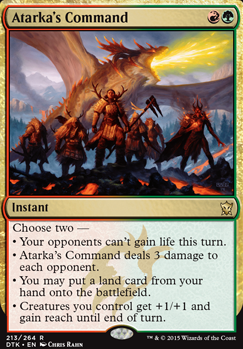
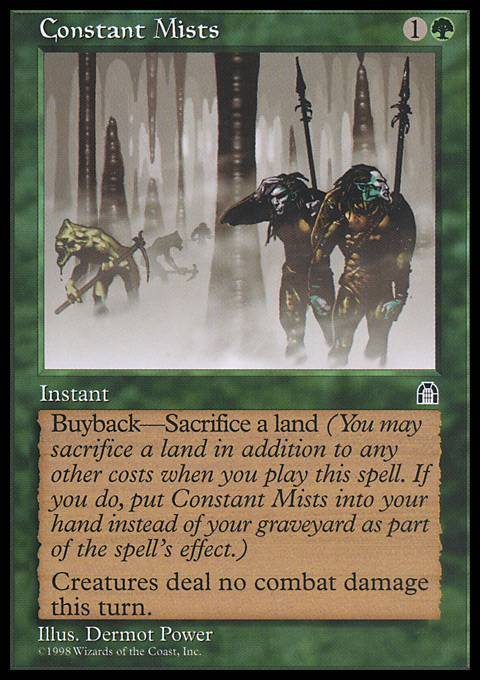
These cards overcome the 1 land a turn rule or buyback the sacrificed land. Here the non-mana upkeep cost of Glacial Chasm plays to the deck's advantage. It eats a land but then gives us time to catch back up on our mana. Atarka's Command is a one-shot, but instant speed Chasm + preventing life gain gives it enough utility for me to like it. These are ways we persistently get ahead of the sacrifice. Things like Kodama's Reach and Explosive Vegetation put us ahead for the first time we play Chasm.

I say the first time we play Chasm because it would not be useful to have it in play the whole time. As stated, we do have to win. There's some consideration for playing non-combat win conditions. However, the one that lines up the best in our space is Borborygmos. I don't want this to be a Captain Sisay style deck where the real general is in the 99. He might make the cut, but I'm not devoting space to the angry land man. Most other R/G win conditions involve attacking. Its possible to play a colorless-combo, its just not exciting. We are also basing this on the punishing power of Ruric Thar, so having a damage oriented win condition is going to be important. Chasm can eat itself, but there should also be some other ways for the deck to get rid of it.
        
A couple of these not only eat Chasm if we already have it, they also function as ways to find it. I'm a bit iffy about the inclusion of Aggressive Mining. Its a powerful card. The trade-off on it is pretty glaring though. However it does work well with Burgeoning and Budoka Gardener, so I'm leaving it in. That's the core of the deck's engine. What we need now are ways to deal damage.        
The deck is building itself around single large attack steps since it's likely that we won't have perfect control over when Chasm is in play. There are going to be times when its the only thing discouraging people from attacking us. During the windows we have to attack, having lots of equipment and buffs for a Knockout Punch is going to valuable. Urabrask opens windows later in the game and his second line is very powerful for shutting down instant speed blockers. Seize the Day is just shy of a general damage kill on its own, so any buff or a previous attack is likely to make it a lethal threat. Proper timing of casting Seize the Day will be necessary to ensure Ruric doesn't punch us while Chasm is down. Its possible more Overrun effects would be better in the deck, but they don't do a lot unless you have enough to capitalize on them.
     
 
The tokens makers for the Overrun effects. Bodies are very useful for the deck. They provide blockers for when Chasm isn't on the table and generally win the game. They can crush through an open attack window with an overrun. Titania and Hammer are of particular importance given the rest of the deck's construction.

The foundational idea of the deck was as an entry in the punisher archetype though. Ruric accomplishes that well on his own but he could use some back up.
       
These cards continue the Punishment theme. I'd like to expand on them and other cards that exploit the broken symmetry that occurs when you have Glacial Chasm in play, but the deck is already tight and eight cards isn't a small commitment.

The deck wants a ton of acceleration to play a 6 mana general that you want out before the table has emptied its hand:
            
A 6 mana general that we want to have in play as much as possible that has a huge target on his head is going to need to be recast a fair number of times. The lands to play ramp also enables Aggressive Mining if that card winds up staying in the deck.
                     
That's the basic deck. It has everything you need to start. There are some simple power ups that might be expensive or repetitive to add so I omitted them from the main list. This deck could definitely use a Gaea's Cradle, a Tooth and Nail, a Taiga, a Regal Force, and Borborygmos Enraged. Also a Sylvan Library and more of the traditional card draw spells. Again, if these are within your budget and you don't might putting Tooth and Nail in another deck, by all means include them.

A note on playing the deck, getting to Glacial Chasm is very important. All three of the tutors in the deck can get it, but you won't always have it. Without Chasm, you should be more aggressive till you find it. You are threatening a lot of damage with Ruric so use that to make space for yourself. Another category of cards you could add if you want to power the deck up are more tutors for consistency, like Gamble.

I also omitted Battle For Zendikar cards for this build since we're still a week away from the Pre-release, never mind actual release. However, these cards all look like potential includes:     

I hope you guys liked this article and I'll be back next week where I will start tackling some of the new legends in Battle for Zendikar! Cheers!